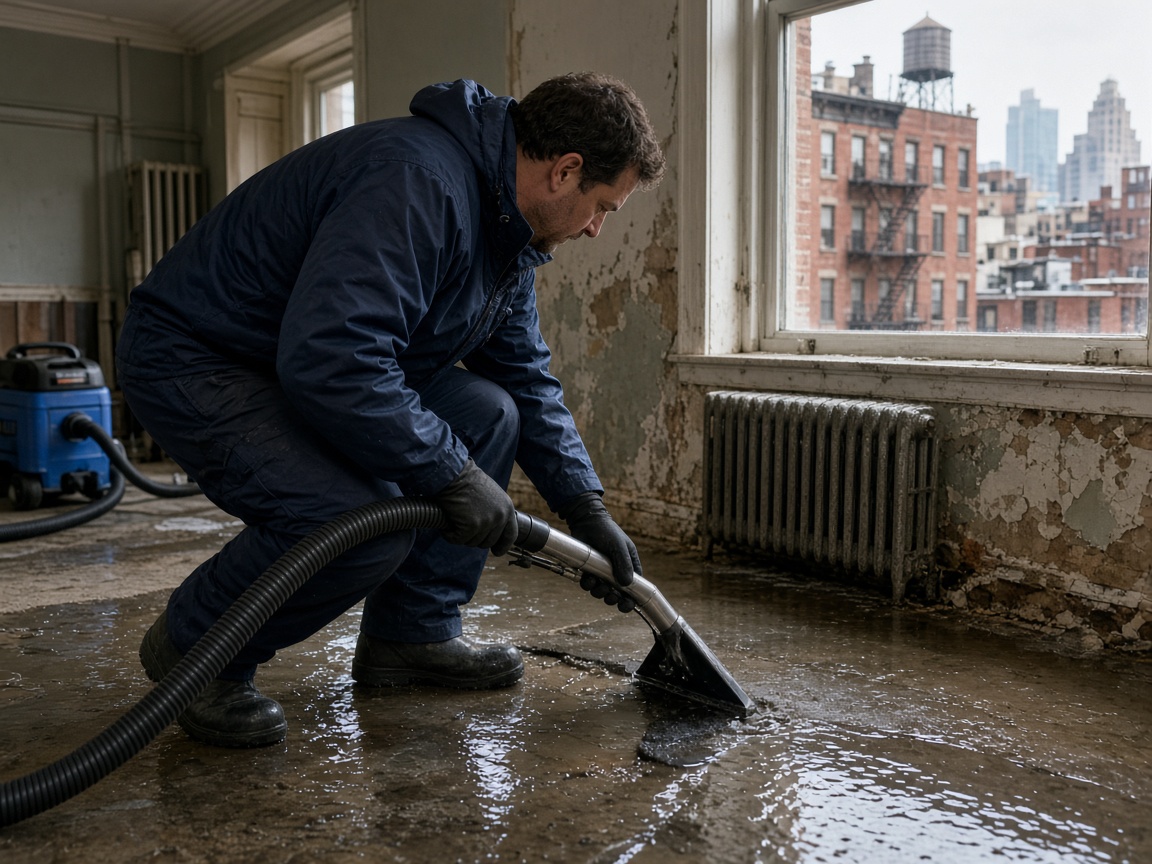
Jersey City’s older row homes and brownstones in Paulus Hook Historic District and Van Vorst Park often have cast-iron pipes and knob-and-tube wiring that fail during cold snaps. When winter temperatures drop below freezing, these pipes burst in unheated basements, sending water into lath-and-plaster walls that wick moisture upward and trap it behind layers of paint. Restoration crews must open walls carefully to avoid disturbing historic finishes while still reaching hidden wet cavities.
Hudson County’s humid subtropical climate brings heavy summer thunderstorms that overwhelm combined sewer systems, especially in low-lying blocks near Liberty State Park and Exchange Place. Water backs up through floor drains and carries silt from the Hudson River, leaving behind fine sediment that holds odor and promotes mold on oak flooring common in pre-war buildings. Extraction must include subfloor drying and antimicrobial treatment before refinishing.
Newport and Hudson Exchange high-rises face different risks from roof leaks and HVAC condensate line failures that drip into units below. These jobs require coordination with building management to isolate water on multiple floors while protecting elevator shafts and electrical rooms. Drying times stretch longer in sealed concrete structures where airflow is limited compared with wood-frame homes in The Heights or Greenville.
Proximity to Bayonne, Hoboken, and Newark means crews routinely cross county lines for shared equipment when large storms hit multiple municipalities at once. Local operators keep extraction trucks and dehumidifiers staged at the 14th Street shop so response stays under two hours even during rush-hour traffic on the Turnpike.
Technician insight
In Jersey City the thing that catches most people out with Emergency Water Damage Restoration is how quickly water travels through the shared party walls of 100-year-old row homes in Paulus Hook and Van Vorst Park. One burst pipe can soak three neighboring basements before anyone notices because the clay soil here holds moisture against foundations for weeks.
Burst Pipe in Paulus Hook Brownstone
A supply line froze and split in the basement of a pre-war row house near the Paulus Hook Historic District. Water migrated under the oak floor into the adjacent unit. Crews isolated the leak, extracted water from both properties, and ran drying equipment for six days until moisture readings returned to normal. The owners avoided mold growth and kept the original flooring.
Emergency Water Damage Restoration Services We Offer
✓Burst Pipe Water Extraction
Rapid removal of standing water from burst supply lines common in Paulus Hook and Journal Square row homes, followed by targeted wall and floor drying.
✓Sewage Backup Cleanup
Safe extraction and disinfection of Category 3 water from combined sewer overflows that affect basements near Liberty State Park and Bergen-Lafayette after heavy rain.
✓Storm Flood Restoration
Pumping and drying of rainwater intrusion in low-lying areas around Exchange Place and Newport during summer thunderstorms and nor’easters.
✓Hidden Moisture Detection
Thermal imaging and moisture meter scans through plaster and hardwood floors in older Hudson County homes to locate trapped water before mold sets in.
✓Subfloor Drying and Repair
Removal of saturated plywood or hardwood subfloors in Greenville and The Heights properties, followed by structural drying and replacement.
Emergency Water Damage Restoration Cost in Jersey City, NJ
| Service | Typical Range | What Affects It |
|---|---|---|
| Initial Assessment And Moisture Mapping | $150–$300 | Waived if full restoration proceeds |
| Water Extraction (Per 1,000 Sq Ft) | $800–$1,600 | Depends on water depth and Category level |
| Drying Equipment Rental (Per Day) | $200–$450 | Air movers, dehumidifiers, and monitoring |
| Sewage Backup Remediation Add-On | $1,200–$2,500 | Includes biohazard handling and disposal |
Ranges are typical for Jersey City, NJ and confirmed with an exact written quote before any work starts.
How it works
- 1
Arrival And Safety Assessment
Technician arrives, shuts off water source if still flowing, and checks for electrical hazards before any extraction begins.
- 2
Water Removal
Truck-mounted pumps and portable extractors pull standing water from floors, carpets, and wall cavities.
- 3
Drying And Monitoring
Air movers and dehumidifiers run while daily moisture readings track progress in affected materials.
- 4
Sanitizing And Restoration
Antimicrobial application and removal of damaged drywall or flooring prepare the space for rebuild.
Pricing
Pricing varies by volume of water, number of affected rooms, and whether Category 3 contamination is present. Upfront written quotes provided after inspection.