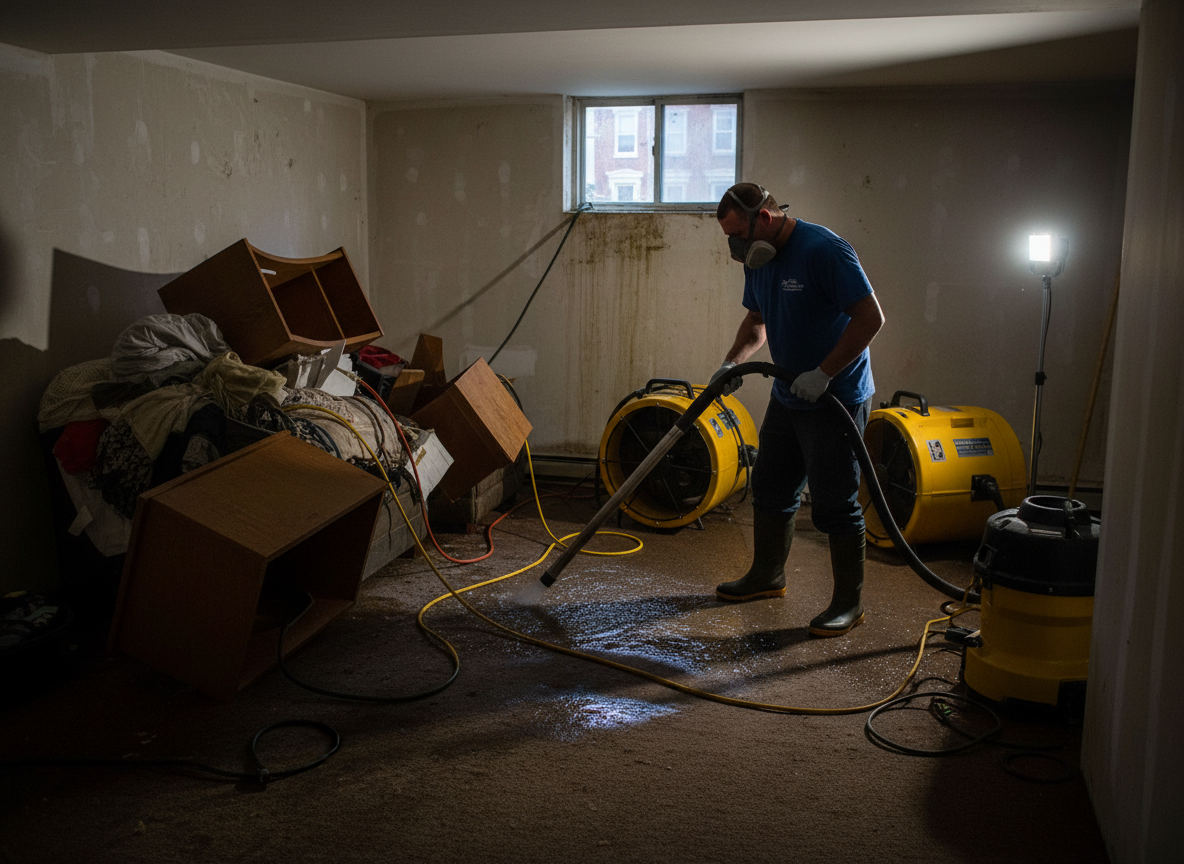
Jersey City row homes and multi-family buildings from the early 1900s in Paulus Hook and Van Vorst Park often have plaster walls and original flooring that trap moisture after leaks. When water enters through shared walls or from above, crews must pull baseboards and use moisture meters to find hidden saturation before mold sets in during the humid summers. Cold winters bring pipe bursts in uninsulated spaces common in The Heights and Greenville, requiring targeted drying that accounts for the tight floor plans and limited airflow in these older structures.
Hudson County flood events frequently affect ground-level units near Liberty Harbor and Exchange Place because of the low elevation and proximity to the Hudson River. Extraction equipment must handle both clean water and contaminated runoff that carries street debris. Technicians run commercial air movers and dehumidifiers for extended periods because the subtropical climate keeps relative humidity high even after the rain stops, slowing evaporation in concrete basements and crawl spaces.
Newport and Hudson Exchange high-rises experience different issues when rooftop drains fail or washing machines leak on upper floors. Water travels quickly through slab penetrations into units below, so cleanup includes documenting migration paths for insurance and using HEPA filtration during demolition to control dust in occupied buildings. Crews coordinate with property managers to protect elevators and common areas while moving equipment in and out of tight service corridors.
Technician insight
In Jersey City the thing that catches most people out with water damage cleanup is how quickly moisture travels through the brick and plaster party walls in 1920s row homes in Journal Square and Paulus Hook. One leaking pipe on the second floor can saturate three units because there is no modern vapor barrier, and the humid subtropical summers keep everything from drying on its own.
Basement Flood After Heavy Rain in Greenville
Water entered a 1940s row house basement through a cracked foundation wall after a summer storm. Crews extracted several inches of contaminated water, set drying equipment, and removed saturated insulation before mold could form. Daily monitoring confirmed dry readings within five days, allowing the owner to begin repairs without further hidden damage.
Water Damage Cleanup Services We Offer
✓Emergency Water Extraction
Rapid removal of standing water from basements and ground floors in neighborhoods like Journal Square and Bergen-Lafayette before it migrates into shared walls.
✓Structural Drying and Dehumidification
Placement of industrial drying equipment in older Hudson County buildings to pull moisture from plaster, joists, and subfloors after pipe bursts or storms.
✓Sewage and Contaminated Water Cleanup
Safe removal and sanitization of Category 3 water in areas near Liberty State Park where storm drains can back up into lower-level apartments.
✓Content Cleaning and Pack-Out
Inventory, cleaning, and temporary storage of furnishings and belongings affected by water in multi-unit buildings around Newport Centre.
✓Post-Flood Mold Prevention
Application of antimicrobial treatments and moisture control in The Heights and Greenville homes after seasonal flooding to stop growth in humid conditions.
Water Damage Cleanup Cost in Jersey City, NJ
| Service | Typical Range | What Affects It |
|---|---|---|
| Emergency Water Extraction | $600–$1,800 | Varies with volume and access in multi-story buildings |
| Full Structural Drying | $800–$2,500 | Longer in older plaster homes during humid months |
| Sewage Cleanup Add-On | $400–$1,200 | Includes containment and disposal |
| Content Pack-Out Service | $350–$950 | Based on number of rooms and items |
Ranges are typical for Jersey City, NJ and confirmed with an exact written quote before any work starts.
How it works
- 1
On-Site Assessment
Technicians arrive from the 14th Street base and document moisture levels, affected materials, and migration paths in the specific Jersey City property.
- 2
Water Removal
Pumps and extraction tools pull standing water while protecting adjacent units common in Paulus Hook and Liberty Harbor buildings.
- 3
Drying And Monitoring
Air movers and dehumidifiers run with daily moisture checks until readings return to normal for the building's age and construction type.
- 4
Final Sanitation And Clearance
Surfaces are treated and the space is cleared for reconstruction once all hidden moisture is confirmed gone.
Pricing
Pricing depends on water category, affected square footage, and drying duration; assessments are provided during business hours.